

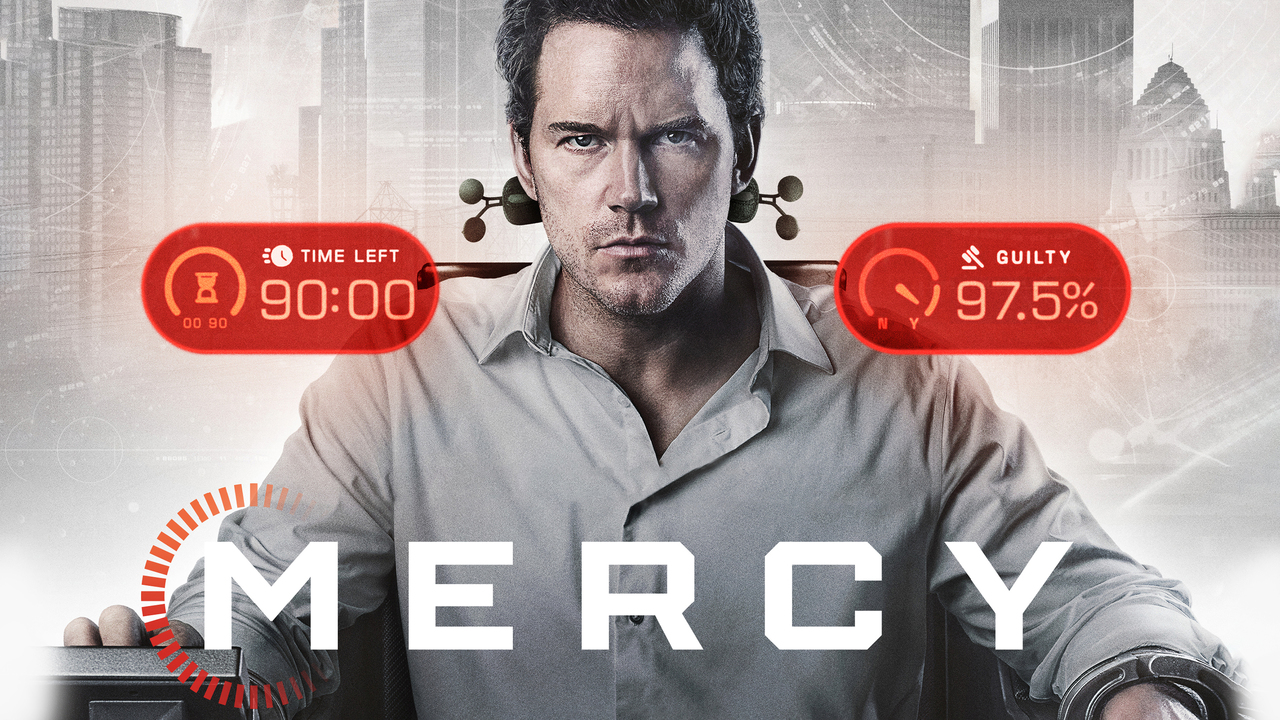
LAPD Detective Chris Raven has had a long and storied career in law enforcement due to his introduction of the Mercy court, which rapidly tries and executes presumed guilty criminals. But when Raven wakes up after a mysterious blackout and learns that his wife has been murdered and he’s on trial for her death, he has to prove his innocence to an AI judge presiding over the trial. Did he commit the crime… or is there more than meets the eye here?
2026 in film has finally begun, and for me, MERCY was the first screening of the year. The film teams the ever-charismatic Chris Pratt up with director Timur Bekmambetov, a man whose directorial credentials are all over the place, ranging from fare like ABRAHAM LINCOLN: VAMPIRE HUNTER to the ill-fated BEN-HUR remake from 2016. What happens when you team these individuals up to make a movie?
MERCY has some interesting ideas, and a surprisingly powerful performance from Chris Pratt in its fairly concise running time. But the movie also falls victim to many cinematic cliches, and despite its best intentions, doesn’t really bring anything new to the respective genres it explores. It’s a good movie; not a great one.
Where the most credit is due here is Chris Pratt’s performance. Pratt has long been known for is on-screen charisma and likeable, goofy character. Bekmambetov’s script doesn’t allow Mr. Pratt to go into comic relief mode, but this actually works to his benefit here, putting the actor through the ringer and forcing a darker and more dramatic performance out of him. To this critic’s surprise, Pratt is up for the task. Here’s a flawed but still sympathetic character in a (literal) trial for his life, and the desperation he unleashes on screen shines through throughout. He stars opposite an AI judge played by Rebecca Ferguson and a cast of supporting players that includes family members, fellow officers, and other acquaintances, but this is Pratt’s show first and foremost. And he owns the screen every second he’s on it.
The movie has an interesting enough premise, attempting to clean up the mean streets of Los Angeles with a “guilty until proven innocent” concept, but the execution of this is hit and miss. If the Mercy courts are so effective, why are there still camps of vagrants and criminals (or as the movie called them, “red zones”) throughout the city? While there are some gripping moments, the movie doesn’t really make any strong arguments for one side versus the other. In some ways it’s a slightly less futuristic MINORITY REPORT, with even the conclusion being strikingly similar to that film.
If there’s one big flaw that works against MERCY, it’s that it doesn’t give us anything we haven’t seen done better in another film. The movie throws it far too many plot twists, particularly in its final moments, which are hard to swallow (again, these are strikingly similar to moments in MINORITY REPORT). At times the film goes overboard with red herrings and characters and elements that never get the fleshing out they deserve. Nearly everyone we see in this movie feels like a stock stereotype we’ve seen in other films.
MERCY is not a bad movie (it’s better than a lot of the January “dumping ground” fodder moviegoers and critics get), but there’s nothing particularly great about it other than Chris Pratt’s performance, which is a strong dramatic turn for the usually comic actor. This one’s worth streaming, but not the trip to the theater.