

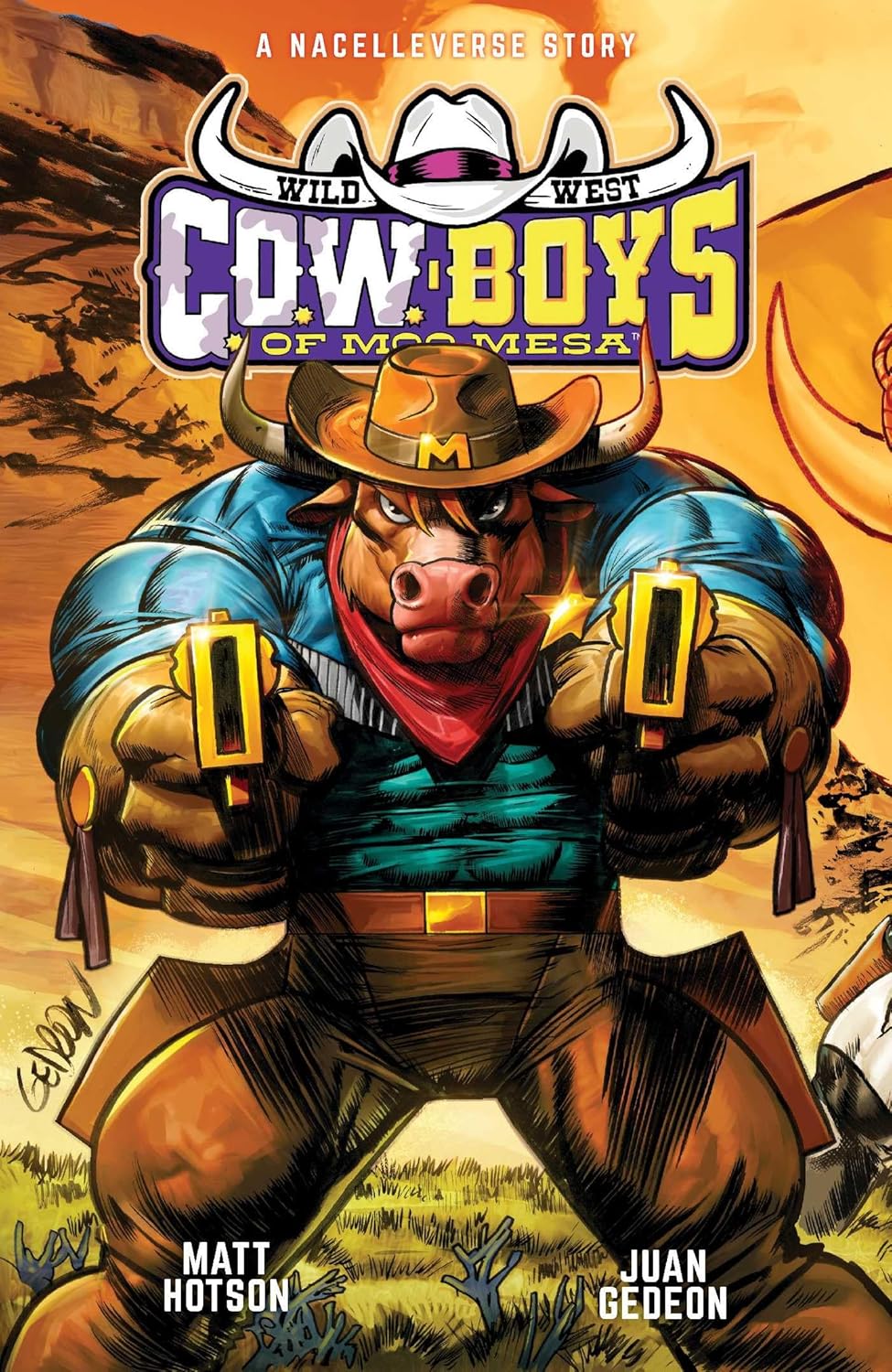
Almost a year after making its debut, Oni Press’ comics mini-series, Wild West C.O.W.-Boys of Moo Mesa is getting a full single volume release. The four-issue limited series, which is based on the cult classic ABC Saturday Morning animated series, will be presented in a trade paperback collection July 14 in comics shops everywhere. The appeal herein comes in part through the featured story, which will be discussed shortly. The writing and art within the story builds on the appeal established through the story, increasing the engagement and entertainment even more. Putting the final touch to the whole is its price point, which will also be discussed later. Each item noted is important in its own way to the whole of this collection. All things considered they make Wild West C.O.W.-Boys of Moo Mesa well worth the wait among fans of this rejuvenated property that hopefully will continue past this collection of issues, which started out as a miniseries.
Oni Press’ forthcoming full presentation of its miniseries, Wild West C.O.W.-Boys of Moo Mesa is an offering that fans of this series and of the animated series that spawned this production will appreciate. The book’s appeal comes in part through its featured story. Written by Matt Hotson and spanning approximately 96 pages, the story is one part classic western and one part action/science-fiction tale. It centers on Marshal Moo Montana as he takes the reigns (no pun intended) as the lead lawn…er…horse…cow?…in the wild west municipality of Cowtown. The story opens with Montana having a dream throwing back to his early days as a student to his then mentor, Marey Quine. In the flashback, readers learn that Marey played a pivotal role in Moo Montana’s development as a law enforcement official. She also makes an important but brief statement about how they all came to be the anthropomorphic beings that inhabit this world, noting it was the result of radiation from a comet that passed over the region. This plays into the story as each issue progresses and will be addressed a little later.
As Moo’s flashback dream ends, the story shifts to the present, with Moo arriving aboard a train in Cowtown, where he immediately learns that Marey, who had been the town’s sheriff, has gone missing. While the story does not clarify how much time had elapsed between that flashback introduction and the present, clearly a certain amount of time has passed.
Moo is introduced to Cowtown’ residents by the town’s crooked mayor soon after his arrival, with the Mayor announcing that Moo has been sent by law enforcement at a higher level to take over as Sheriff in Marey’s absence. The townspeople are not initially happy about the announcement, but Moo says he is not looking to hang around, either. Rather, he just wants to find Marey and bring her back. This seems to do the job, at least the for the town’s residents. Not everyone is happy, as the mayor’s crony, Terrorbull, who wants to be the new sheriff, makes clear.
Later in the day, Moo meets his first foe, Dark Horse after the armored anonymous villain tries to kidnap one of the town’s children. Moo and his soon-to-be partners show up and try to stop Dark Horse. Their efforts are for naught, though, as Dark Horse escapes with the youth, setting up the story that is to come. The story in question is the search not only for the child and other missing townsfolk but also for Dark Horse. Moo and his new friends locate the missing townspeople and Dark Horse, which leads to a big fight scene that also includes the trio’s now mutated horses. The horses have been turned wild thanks to shards of the comet that turned Moo and so many others into the anthropomorphic beings that inhabit Cowtown. Herein is that hindsight importance of Marey’s subtle comments in Moo’s dream. The catch here is that Dark Horse has done something more to the horses that has made them into “monsters.” This is another item that Hotson eventually raises as the miniseries progresses.
As it turns out (not to spoil the story for anyone who has yet to read this tale) Dark Horse had been doing some experimentation for some time in an effort to return Cow Town’s residents back to their wild state. This is revealed in the final issue along with Dark Horse’s true identity, which leads up to the surprising climactic finale. Even after Dark Horse’s defeat, Hotson leaves the door wide open for this miniseries to become an ongoing series and considering how engaging and entertaining this story proves, one can only hope that Oni Press will do just that, make it an ongoing series.
The story featured in the pages of this collection makes for plenty of reason in itself for audiences to own this collection. Building on the appeal is the writing within the story. Once again, not to play spoiler, but Moo Montana’s back story, which makes up at least a portion of Issue #1, plays directly into the story’s outcome. The very use of the dream sequence as a back story is well thought out. Where so many origin stories spend far too much time establishing back story, Hotson’s work here wastes no time in establishing Montana as the story’s main character while also establishing his persona as that heroic figure.
On a related note, Marey’s subtle comment during the flashback regarding the role of the comet that turned almost everyone into the anthropomorphic beings that inhabit that world proves key in the long run. That Hotson treated this comment as an aside early on is just as smart. That is because at first he makes it so subtly that no reader would otherwise think twice about it even as it clearly becomes an important part of the story.
Staying on that matter, that Hotson directly addresses regular animals becoming almost humanoid is in itself somewhat funny considering how commonplace it has been in cartoons and animation for generations. It is almost a breaking of the fourth wall, so to speak. That he would go this route is truly something unique, especially as Dark Horse forces Moo and his partners to face off against mutated versions of the very horses they ride. In so many cartoons and comics out there, the anthropomorphic creatures have animal pets themselves, and it has always been a point of contention. So, for Hotson to kind of poke fun at that in these pages is in hindsight, pretty fun and funny even in this action setting.
In the story’s epic conclusion, Dark Horse (Dark Horse’s real identity will not be revealed here so as to not spoil anything) makes a commentary about how none of them should exist. “That’s what we’re supposed to be! Wild and thoughtless and free!,” says Dark Horse in this moment. “These minds are a burden! These bodies are a prison!” Dark Horse continues, “We don’t need money, or courthouses or jails or laws! We take the humans’ buildings, and their jobs, and live like them, but we shouldn’t!” This existential diatribe is actually a pretty heavy matter; heavier than any of the stories featured in the original animated series. Why are such beings the main characters of so many animated franchise? It actually makes for quite the discussion when one really thinks about it. On another level, Dark Horse’s comments can (and likely will) also bring about discussion among readers about our own place in the world — Where do we belong in the world? What is our role in everything? It is a heavy duty moment that puts the accent on the whole of this miniseries. This unique discussion’s inclusion in what is otherwise supposed to be a title for children is yet one more example of the importance of the book’s writing. When it and the other aspects of the writing are considered collectively, the whole therein makes clear why this story’s general writing is so important to its presentation.
Staying on the matter of the overall content, one cannot ignore the work of artist Juan Gedeon. Gedeon’s art maintains a certain cartoony profile throughout the book’s nearly 100-page run while also ensuring a certain edge to that stylistic approach at the same time. That balance is a nice touch. The colors, the use of light and dark, and the general character and world design adds even more to the appeal of the visual presentation. It means just as much applause should go to Gedeon’s fellow art team members, colorist Carlos Cabrera, and letterer Jeff Powell. The trio’s collective work brings the world of the C.O.W.-Boys of Moo Mesa fully to life in the best way possible. Keeping this in mind, the artwork and writing that went into this miniseries proves just as important to the whole of the book as the story.
Now, understanding and appreciating all that Wild West C.O.W.-Boys of Moo Mesa has to offer audiences from its overall content, it makes the book’s price point a key item, too. The book is listed at $14.99 at all major retailers carrying the title. Target, so far, is the only retailer that seems to not be carrying this title. Considering that this is a four-issue miniseries and that each issue is priced at $4.99, that makes the price right in line with the total price of the four issues themselves. In other words, readers are getting this miniseries in one setting at the same price they would be paying in total for each of the four issues that make up the book’s whole. What’s more, they are paying that price to have all four issues in one place rather than having to keep up with each standalone issue. That in itself is even more for readers to like about this collection. Add in, again, how much the book has to offer, and audiences get in whole a presentation that is well worth its noted fully affordable price.
Oni Press’ forthcoming full presentation of Wild West C.O.W.-Boys of Moo Mesa is an enjoyable, appealing offering for fans of this series in so many ways. On one hand, readers get a great action-packed wild west/sci-fi story whose writing and art do plenty to keep audiences fully engaged and entertained. On another, it is offered at a fully affordable price that will not break any reader’s budget. Each item examined is important in its own way to the whole of the book. All things considered they make Wild West C.O.W.-Boys of Moo Mesa a fun read that is sure to leave readers hoping (like this critic) that this limited series will become an ongoing series.
Wild West C.O.W.-Boys of Moo Mesa is scheduled for release July 14 in comics shops everywhere. More information on this and other titles from Oni Press is available at:
Website: https://onipress.com
Facebook: https://facebook.com/onipress