

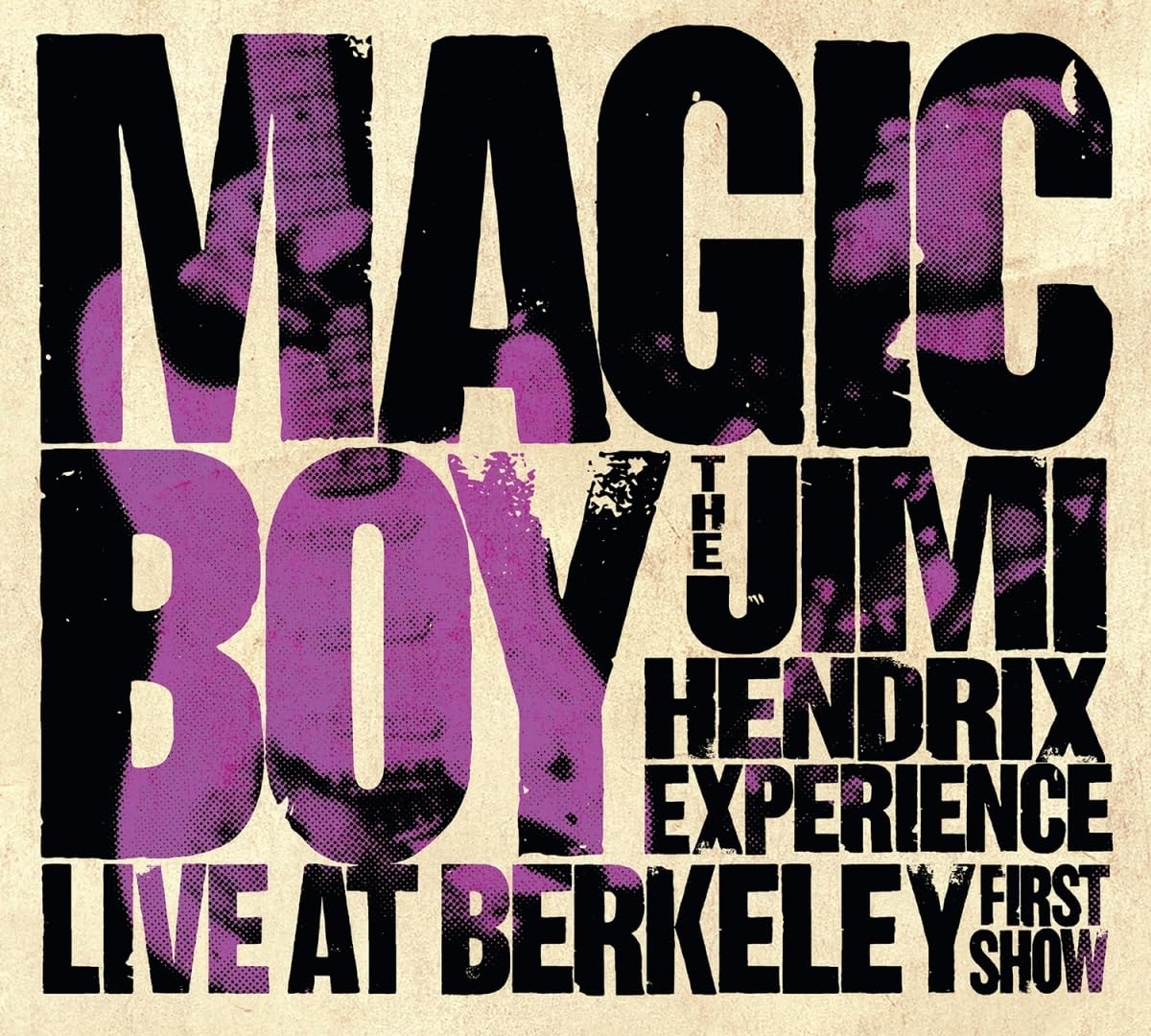
Late last month, Legacy Recordings and Experience Hendrix, LLC released another archived Jimi Hendrix Experience to the masses in the form of Magic Boy: The Jimi Hendrix Experience Live at Berkeley – First Show. If the title sounds familiar, it should. That is because back in 2003, the companies released the second set from that May 30, 1970 two-show presentation exclusively on vinyl in the form of Live at Berkeley. It was then re-issued in 2012 on CD. This new recording is actually the first of the two performances. Its presentation is highlighted by the concert in general. This will be discussed shortly. The companion booklet that accompanies the recording makes for its own interest. The concert’s audio restoration puts the finishing touch to the whole, completing the presentation. Each noted item is important in its own way to the whole of the recording. All things considered they make Magic Boy: The Jimi Hendrix Experience Live at Berkeley another must-have for any Hendrix fan.
Legacy Recordings and Experience Hendrix, LLC have released over the years, so many wonderful, archived concert recordings from The Jimi Hendrix Experience. That goes without saying. From the group’s performance at the famed Hollywood Bowl, to its concert in Maui, Hawaii, to the Atlanta Pop Festival to, well, Berkeley, CA and more, the concerts released through the companies’ partnership have been excellent offerings, needless to say. Late last month, that Berkeley performance was revisited in the form of Magic Boy: The Jimi Hendrix Experience Live at Berkeley – First Show. The companion to the companies’ 2003/2012 recording, this presentation proves so enjoyable in part through its very presentation. As noted, it is the first of the two performances that the group held on May 30,1970 at the Berkeley Community Theatre in Berkeley, CA. Save for the final three songs (likely encores), the first show’s set list is completely different from that of the second set, which would be held later in the evening that same day. So, to that end, audiences get here, a completely different concert from the previously released second show.
What’s more, the first show actually exhibits the band going into jam session mode (for lack of better wording) than in the second show. That evening concert saw at best, two jam sessions – in the group’s performance of ‘Machine Gun’ and the closer, ‘Voodoo Child.’ By comparison, the trio’s performance of ‘EZ Rider,’ ‘Red House,’ ‘Machine Gun,’ ‘Hear My Train A Comin,’ and ‘Voodoo Child’ all become those jam sessions, extending the concert far longer than the second set. This is important because it makes the first concert feel so much more organic than the second set, which seems more like the band going through its list. This is likely because of the young UC Berkeley Students protesting outside because of the lack of tickets for the concerts. This is actually addressed in the recording’s companion booklet. It will be discussed later. Maybe knowing the students were swarming the theatre made for some tension inside even though Hendrix and his fellow musicians seemed cool and collected throughout both sets. Regardless, that general presentation of the performance here is its own presentation separate from that of the second show, giving its own unique appeal through the songs and performance.
As if all of that is not enough, audiences will especially appreciate Hendrix’s casual presence throughout the concert. His presence between songs is so genuine and personable. During the songs, he and his band mates (drummer Mitch Mitchell and bassist Billy Cox) are solid in every song. Mitchell’s talent on drums is especially on full display while Cox does his own thing just as well. The whole therein makes for a full performance that makes for even reason for audiences to appreciate the concert itself.
The very concert presented within Magic Boy is itself reason enough for any Jimi Hendrix devotee to own this recording and not the only reason, either. The companion booklet that comes with the recording gives audiences even more reason to add the recording to their music libraries. The history provided in the booklet adds to the richness of the recording. Case in point is the note of the UC Berkeley students protesting outside the Berkeley Community Theatre, wherein the Jimi Hendrix Experience held its two concerts. As is noted herein by Joel Selvin, “Demand for tickets far outstripped the BCT’s modest 3,300-seat capacity. Several thousand disappointed ticket seekers swarmed the plaza in front of the theater and rushed the doors…Rocks were thrown at concertgoers. Fans who actually had tickets had to elbow their way through the angry mob.” That is a pretty telling visual. People were that crazy to get in to see the Jimi Hendrix Experience.
This is just one of the interesting items that Selvin shared in the liner notes. He later points out that a film crew had been hired to come in to record the concert. As Selvin points out, “Nobody bothered to tell concert promoter Bill Graham, who threw a predictable fit.” So there in itself is more drama tied into the concert. As if that is not enough, Selvin adds that Hendrix’s manager, Michael Jeffery “had neglected to pay [Director Peter] Pilafian.” So, “the director never even developed the film, simply shelving the cans of footage.” Even when the footage was later restored, Selvin writes, the quality was so bad that it left the footage “unusable.” The whole story therein will be left for readers to discover for themselves. It is certainly enlightening to say the very least. All of the history that Selvin provides here makes for so much engagement and entertainment in its own right.
Staying on the matter of the footage, Selvin’s history provides a rich explanation of why an actual audiovisual presentation of the two concerts is so rare. To that end, it explains why only the audio has ever been released. To that end, the audio production herein is actually positive even though audiences will find themselves having to adjust the volume throughout between songs. When Jimi is not singing, audiences have to turn up the volume. When he and his band mates are performing, the volume has to be reduced. Yet even with that in mind there is something “organic” about it that makes the sound still a positive in its own right. Keeping that in mind, the general audio presentation herein, considered alongside the performance and the recording’s companion booklet, the whole makes Magic Boy: The Jimi Hendrix Experience Live at Berkeley – First Show another largely successful archived Hendrix Experience concert recording.
Magic Boy: The Jimi Hendrix Experience Live at Berkeley – First Show is a largely solid new presentation that Hendrix fans and rock fans alike will appreciate. This is proven in part through its featured concert recording itself. The concert features a set list completely separate from that performed in the second show. The band’s performance feels so organic throughout, too, making for even more appeal. The history provided in the recording’s companion booklet adds to the appeal because of all that it presents in itself. The audio restoration puts the finishing touch to the whole. While it is uneven, there is still something about it that is still enjoyable. Each item examined is important in its own way to the recording. All things considered they make Magic Boy: The Jimi Hendrix Experience Live at Berkeley – First Show another welcome addition to the music libraries of any and every Jimi Hendrix (and rock) fan.
Magic Boy: The Jimi Hendrix Experience Live at Berkeley – First Show is available now. More information on this and other Jimi Hendrix Experience recording is available at:
Website: http://www.jimihendrix.com
Facebook: http://www.facebook.com/JimiHendrix
Twitter: http://twitter.com/JimiHendrix