

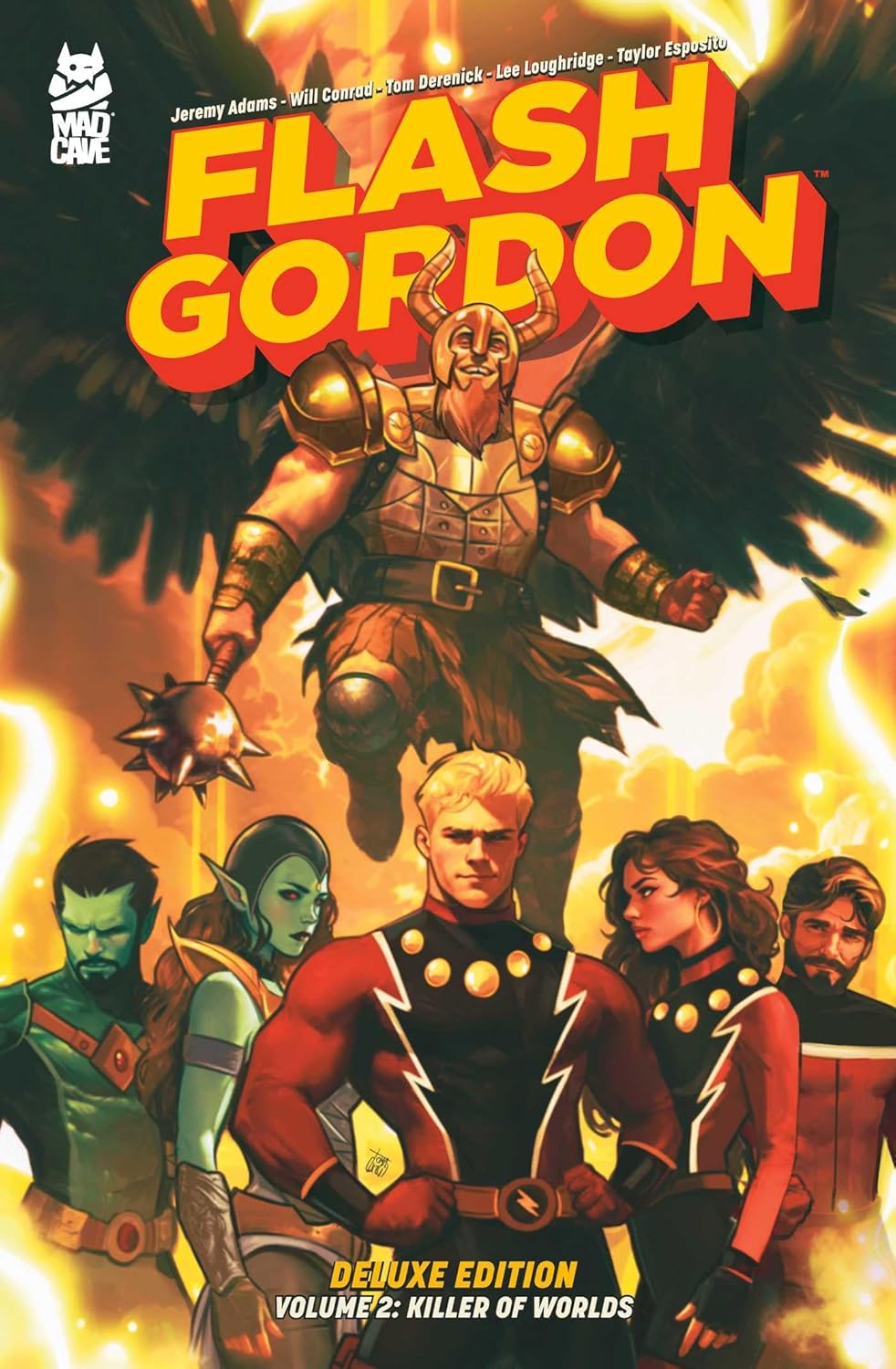
This summer, Mad Cave Studios will officially wrap the first run of its hit Flash Gordon comics series when it releases, Flash Gordon Volume 3 in a trade paperback pressing. The volume’s hardcover edition will follow Dec. 29. It will collection Issues 11-15 from the series’ initial run. While readers await its release on their chosen platform (this critic is personally more a fan of hardcover books than paperbacks in every form), they still have another “chapter” in the series’ initial run to take in, in the form of Flash Gordon Volume 2: Deluxe Edition. Released Apr. 28, roughly eight months after the volume’s initial release on trade paperback, Flash Gordon Volume 2: Deluxe Edition is an enjoyable new presentation for fans of this franchise. That is due in part to its featured story. The writing contained within the story builds on the appeal ensured through the story. The bonus content that accompanies the collection puts the finishing touch to the presentation. Each item noted is important in its own way to the whole of the presentation. All things considered they make Flash Gordon Volume 2: Deluxe Edition another positive offering from Mad Cave Studios.
Mad Cave Studios’ recent hardcover release of Flash Gordon Volume 2 is an interesting new presentation that audiences are sure to appreciate. Released more than eight months after the company released the collection in its trade paperback presentation, this new collection proves worth read in in part through its story. Spanning Issues 6-10, the 152-page collection picks up where the series’ left off after the series’ first arc. In that arc, Flash Gordon and his allies have escaped Planet Death, which just so happens to be ruled by an evil version of Dale Arden from another dimension. Yes, it’s the evil other dimension clone plot. Ironically, they get away in part with help from Flash’s longtime nemesis, Ming The Merciless. Now in this latest installment in the series, the story opens with Flash, Ming and Flash’s friend Zarkov (in his robot body) on an asteroid containing a vault controlled by Ming. Of course, it does not take Ming long at all to double cross Flash, and then things only get worse, as Zarkov’s robot body is infected with a virus that takes over his systems. And then things get even worse in the finale of Issue #6 as a self-destruct sequence that Ming set in motion on his outpost goes full, destroying everything, leaving Flash marooned in space, but only for a moment. He is very quickly found by an old ally who surprisingly is none too happy to see Flash.
King Vultan, the ruler of the Hawkmen, is ready to pass judgement on Flash because the effects of the Unraveler impacted not only planet Mongo but also Sky City, the home of the hawk people. Flash is challenged to a battle to the death by Vultan’s son, Talon very much in the vein of a certain famous episode of Star Trek: The Original Series as a way to pay for what he has caused to the entire universe. This will be addressed in the examination of the writing herein. Luckily for Flash, he defeats Talon, leading to the next chapter on his ongoing journey to be reunited with Dale…or who he believes is Dale. This, too, will be addressed later in the examination of the writing.
As Flash and his friends are reunited, they make their way to Mingo City, where a ball is being held by “Dale” and her fiancée, Aton. It does not take long for Flash to discover that Dale is not who she seems and eventually he finds the real Dale being held in a dungeon. Flash and company are not the only ones who appear at Mingo City. The one and only Ming the Merciless shows up after an epic battle that follows Dale’s rescue and just as Ming is about to retake his throne, who should show up through a portal but an evil twin of Flash. Yes, even Flash has an evil twin. This is where things leave off, meaning there will be at least one more volume of issues to come to finish off this initial run from the series. Considering the overarching story here and everything that happens with all of the conflicts, this is everything that readers have come to know from Flash Gordon going all the way back to his golden age in newspaper comic strips. The nonstop threats are there. The action is there. The exotic backgrounds are all there. The whole is fully engaging and entertaining from beginning to end.
Knowing that the story featured here keeps the action, the tension, etc. moving in this latest chapter of the series’ initial run, it is just part of what audiences will appreciate. One other item worth noting is the writing used throughout the story. Now, full discretion, the whole matter of the alternate universe with evil twins is hardly anything new to the science fiction realm. Star Trek’s writers already did this twice well before it was used here, once in the original series and then again (to far less success) in Discovery. Even Fox’ cult favorite series, Fringe used a similar sort of arc albeit minus the evil twin bit years ago. That series was so far ahead of its time but that is a discussion for another time. Staying on this matter, writer Jeremy Adams is to be at least somewhat applauded for not just shoving this all-too-familiar plot device in readers’ faces. Rather, he actually keeps readers and Flash himself (as well as Flash’s friends) mostly in the dark until late in this story. How he concluded that arc (at least partially here) is unique in its own way. To that end, the writing in regard to this aspect is deserving of at least some attention in keeping the story engaging and entertaining.
On another note, the noted continued action and adventure that Adams ensures throughout the series’ run thus far is of even more applause. It is everything that readers have come to know and expect from this franchise. Just as with the original newspaper comic series it seems like the danger never lets up for Flash. Every time one issue is solved, another matter rises. Given, there is a little more drama incorporated into the story than was used in the original newspaper strip stories but the whole still maintains that welcome approach. To that end, Adams is deserving of more respect.
Going back to the Star Trek comparison, as noted earlier, Flash’s “reunion” with King Vultan and his son, Talon is a clear throwback to a certain episode of Star Trek: The Original Series. In being accused of destroying not only Planet Mongo but almost an entire galaxy, Flash is challenged to a battle known as “Kravalong.” This battle is essentially a battle to the death in front of an audience for the honor of a people. A similar battle happened between Captain Kirk and his friend and First Officer, Spock in the Season 2 episode, “Amok Time.” The friends faced off in what is known as “lirpas” during the Vulcan mating cycle, “Pon Farr.” The situations are clearly different but at the same time, the setup is inescapably similar. It would be interesting to know if Adams intentionally made the homage to that classic Star Trek episode in this moment, which ironically leads to Flash and Vultan becoming friends again. Adding in the flashback to a key moment between Flash and his own father involving his collegiate future, the moment gains even more unique identity and impact to the overall story. It is just one more of so many examples of how much the writing here does to make this story’s writing engaging and entertaining. When it and the other examined items are considered together with the rest of the book’s writing, the whole therein gives audiences more than enough reason to read this story, especially alongside the impact of the story itself.
Rounding out the most important elements featured in this collection is the bonus content that accompanies the collection. The bonus content in question is quite nice. One of the extras here is an introduction from Doug Murray telling more history on the legacy of Flash Gordon. Where Alex Ross’s introduction in Flash Gordon Volume 1 addressed the artwork of the original Flash Gordon strips, Murray’s introduction (which is also featured in Flash Gordon Classic Collection Volume 1 along with Ross’ noted introduction – Volume 1-6 are available now, all through Mad Cave Studios. Volume 7 is scheduled for release in June, again through Mad Cave Studios) focuses more on the forces that led to the very creation of Flash Gordon by Alex Raymond. From the outbreak of World War I to the Great Depression and the rise of popularity of newspapers and Raymond’s initial attempts to create Buck Rogers, this is where Flash Gordon’s roots lie. The introduction is another interesting piece of history that again, is culled alongside Ross’ own introduction from the previous collection of issues in larger form in Flash Gordon Classic Collection Volume 1, which is available now.
Another extra included herein comes following the cliffhanger finale for this chapter in the story. It comes in another grouping of other Flash Gordon comics. The modern strips are featured in Comics Kingdom and are obviously a modern look at the classic franchise, complete with their own very unique look and writing approach. They are their own interesting read.
As if those short strips are not enough, readers are also treated to sketches that led to the art featured in the book’s pages and the variant covers for Issues 6-10 to boot. All things considered the bonus content featured with this collection adds a nice little “icing” so to speak to the cake that is this collection of issues. When the appeal of the bonus content is considered alongside the positive of the story and its writing, the whole therein completes this book’s presentation, ensuring full engagement and entertainment among readers.
Flash Gordon Volume 2: Deluxe Edition, the latest collection of issues from Mad Cave Studios’ initial run of the noted series, is another engaging and entertaining presentation. Its success comes in part through its story, which keeps the action and tension high from beginning to end for the series. After escaping Planet Death in the first five issues, Flash now must deal with an uneasy temporary alliance with Ming the merciless, of all figures. Then there is an equally tense moment with King Vultan and his son, Talon. From there, there is Flash’s search for Dale, which offers its own action and adventure. It is everything audiences have come to expect from this timeless franchise. Speaking of which, it is just one of so many examples of how much the writing has to offer to make this volume worth reading. The book’s bonus content puts the finishing touch to the whole, making for its own engagement and entertainment. Each item examined is important in its own way to the whole of the collection. All things considered they make Flash Gordon Volume 2: Deluxe Edition another welcome presentation for the most devoted fans of this series.
Flash Gordon Volume 2: Deluxe Edition is available now. More information on this and other titles from Mad Cave Studios is available at:
Website: https://madcavestudios.com
Facebook: https://www.facebook.com/MadCaveStudios
Twitter: https://twitter.com/MadCaveStudios